The Seamless Studio: Why Your Browser Is the Last Creative Tool You'll Ever Need
Creatives toggle 1,200 times/day between apps — losing 5 weeks/year. aukimi is a unified browser-based creative suite: modules, zero exports, $50/year.

THE FATIGUE IS REAL
Open Photoshop. Switch to Blender. Jump to Premiere. Check Discord. Back to Illustrator. Export. Import. Repeat.
This is the modern creative workflow. Ten apps. Twenty tabs. Zero flow.
You're not slow. Your tools are scattered.
1,200 times per day, you switch context. Apps. Windows. Tabs. Files. Mental models. (HBR, 2022)
That number isn't theoretical. It's measured. And it's killing your best work.
THE HIDDEN COST
Context switching isn't just annoying. It's expensive.
5 weeks per year lost to interruptions and task-switching friction (HBR, 2022).
40% productivity drop when you fragment attention across disconnected tools.
But the real cost isn't time. It's creative quality.
Every switch breaks the thread. You lose momentum. You lose the "why" behind a decision. You start choosing the easiest option: not the best one: because your workflow punishes experimentation.
The tool stack you built to help you create is now the biggest obstacle between you and finishing.
THE SEAMLESS STUDIO
aukimi is a unified creative suite that runs entirely in your browser.
One tab. Every module. Zero friction.
Not a collection of separate apps. Not a bundle. A single coherent workspace designed to keep you in flow.
The modules:
- 2D design
- 3D creation
- video editing
- audio production
- game development
- color grading
- motion graphics
- compositing
- texturing
- asset management
- scripting
- project orchestration
They don't just live in the same place. They communicate. Real-time. No exports. No imports. No version chaos.
Change a texture in 2D. Watch it update in your 3D viewport instantly. Adjust timing in the video editor. See the audio waveform sync automatically.
One project state. One source of truth. One uninterrupted workflow.
WHY BROWSER-BASED
The browser isn't a limitation. It's the most practical foundation for professional creative work in 2026.
No installation. Open a URL and create. No admin rights. No setup day. No compatibility matrix.
Hardware independence. Windows. macOS. Linux. ChromeOS. Same workflow. Same performance. Same tools.
WebGPU acceleration. Modern browsers handle real-time 3D rendering, video processing, and complex audio DSP without breaking a sweat. The performance gap closed years ago.
Always current. New features roll out seamlessly. Bug fixes deploy instantly. Your team stays aligned without coordinating updates.
The browser is the only truly universal runtime. If your studio lives there, your workflow stops being tied to one machine.
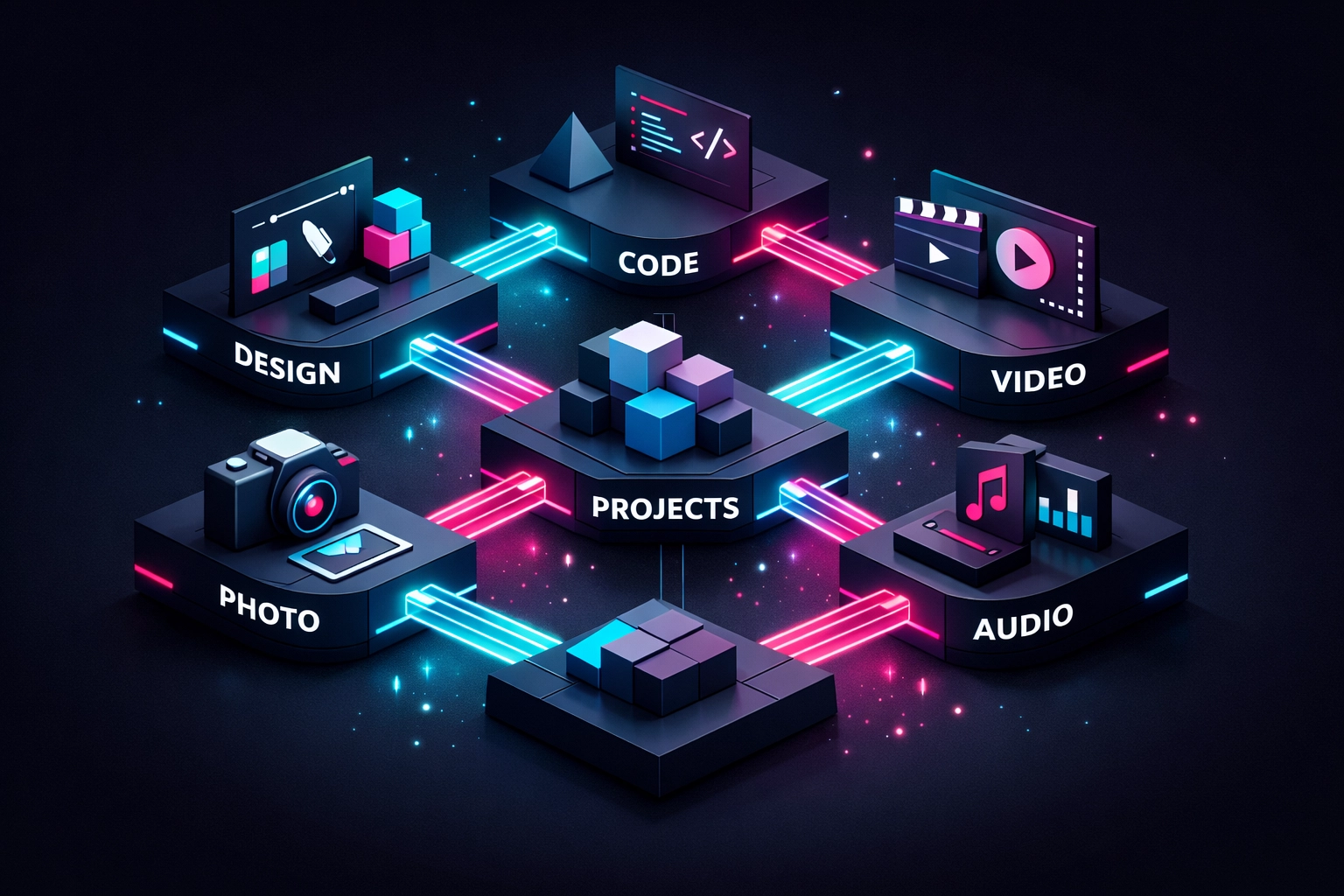
FLOW NOT FRICTION
Traditional creative software operates on a broken model: silos.
You design in one app. Model in another. Edit in a third. Audio somewhere else. Assets scattered across folders. Feedback buried in chat threads.
Every handoff costs you:
- Export settings
- File format compromises
- Manual imports
- Path management
- Version tracking
- Mental context reload
aukimi eliminates the handoff entirely.
Modules share one live project state. Changes propagate automatically. Your 2D edits appear in 3D renders immediately. Video timeline adjustments sync with audio tracks without bouncing files.
No "export/import hell." No wondering which version is current. No stopping creative work to do file management.
Just continuous creation.
This is what "zero friction" actually means: fewer toggles, fewer interruptions, fewer "wait, where's the latest version?" moments.
More uninterrupted momentum.
THE ECONOMICS
Legacy creative software stacks demand multiple subscriptions. Plus powerful local hardware. Plus storage. Plus patience for crashes and license verification.
Adobe Creative Cloud: $600+ per year per person.
aukimi: $50 per year.
That's not "cheap software." That's a different model.
Browser-native delivery eliminates distribution infrastructure. Unified architecture removes platform-specific development overhead. Those savings transfer directly to users.
Professional-grade tools shouldn't require professional-level budgets.
Want the hard numbers? Our latest article breaks down the real-world limitations of Figma, Photoshop Web, and Illustrator — with sources: State of the Browser Studio — 2026.
YOUR NEXT MOVEThe browser revolution isn't coming. It's here.
Try aukimi at aukimi.com and experience what a unified creative workspace feels like.
Want to shape this future with us? Support the build at aukimi.com/crowdfunding.
aukimi is developed by nammu, a Geneva-based web development company focused on building human-first creative technology.
Enjoyed this article?
Related Articles
The Creative Stack Just Collapsed: One Week of AI Tooling, Late April 2026
Between April 27 and May 4, 2026, Adobe, Luma, Novi, fal, Figma, Canva, HeyGen and Anthropic all crossed the same threshold in eight days. Here is what shipped, what it means, and where it leaves the browser-based creative suites trying to consolidate it all.
AI Music and SFX in 2026: What Actually Works in Indie Game Audio
Three years ago, indie game audio meant either licensing royalty-free libraries (cheap, generic, every game sounds the same) or hiring a composer (great, expensive). In 2026, AI generates score that ships. Here is which tools deliver — and where a human composer still wins.
AI Mesh Generation in 2026: What Actually Ships in Game Pipelines
Image-to-3D went from "uncanny demo" to "shipping in indie projects" in eighteen months. Here is what Tripo, Meshy, Rodin, and Hyper3D actually do in production — and where the 3D artist still beats the model every time.
Help Build the Future of Creative Software
Support aukimi development and get exclusive early access to the complete creative suite.